


Monitoring for Healthy Corals: Understanding What Happens Underwater
Water Quality and Sediment Monitoring as Part of Our Coral Restoration
Coral reef restoration is about more than simply planting new corals. To ensure that corals can grow and establish themselves in the long term, we also need to understand the conditions in which they live.
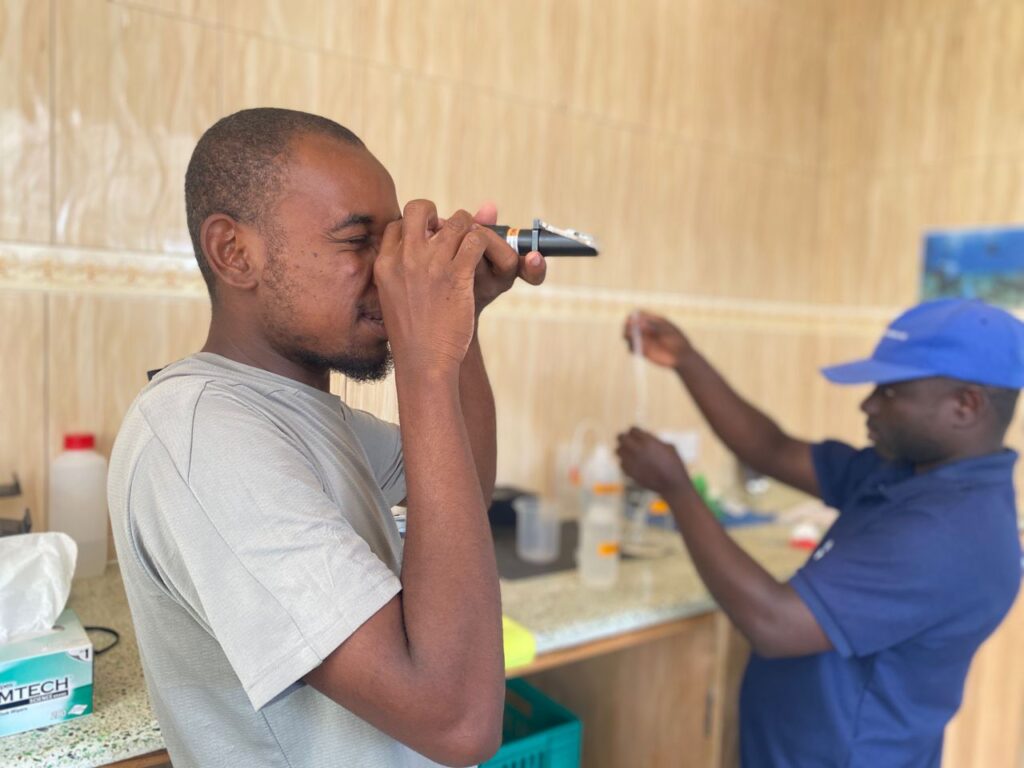
That is why water quality and sediment monitoring is an important part of our coral restoration work. Abbas, our Science Technician, regularly monitors environmental conditions at our restoration sites and collects data that helps us better understand how the reefs are developing.
What does Abbas and the team do?
As part of the water quality monitoring, different water parameters are measured. These measurements show whether conditions at our restoration sites are changing and how suitable the environment is for coral growth and survival.
Sediment monitoring is equally important. Excessive sediment in the water can be problematic for corals: when sediment settles on corals, it can cover their surface and interfere with important processes such as light absorption. For restored corals in particular, we therefore want to understand how strongly our sites are affected by sedimentation.

Why is this data important for our restoration work?
Our corals need more than a stable structure to grow on. The entire surrounding environment matters. Through monitoring, we can observe how water quality and sediment conditions develop over time and relate this information to the growth and survival of our restored corals.
This helps us better understand why corals grow well at one site while facing challenges at another. The data not only supports scientific documentation, but also helps us continuously improve and adapt our restoration methods.
For us, monitoring and restoration therefore go hand in hand: We restore corals – while at the same time learning which conditions they need to build a healthy reef in the long term.
Measure. Understand. Restore. Learn. Through water quality and sediment monitoring, we create the foundation to continuously develop our coral restoration work in a data-driven way.
Many thanks to Sound Ocean Science for helping us establish our monitoring programme. We are building the foundation for long-term, data-driven coral restoration.